By: Tom Reid, Vice President of Power Generation, ENTRUST Solutions Group
Turbine-generator retrofits offer an effective way to extend the life and improve performance of older power plants. However, these retrofits come with risks that can lead to costly downtime if not properly addressed early in the planning process.
At ENTRUST Solutions Group, we specialize in identifying and mitigating these risks. A recent failure of a nuclear retrofit LP last-stage blade highlights the potential consequences, while other retrofits have led to unplanned inspections and modifications.
By conducting a structured technical review, we help ensure that owners can maximize performance improvements while minimizing issues, ensuring a successful retrofit.
Improved performance and output are provided primarily by improvements in turbine blade path design and generator sealing and cooling. Blade path improvements include thermodynamic design (e.g. 3-dimensional reaction blading), sealing enhancements (e.g. brush seals, retractable packing, low diameter sealing), and configuration (e.g. advanced inlet features, conversion from impulse to reaction blading, additional stages).
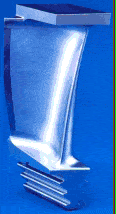
For example, 3-dimensional blade profiles, as shown in Figure 1, account for variation in radial flow and changes in velocities from the base to tip of the blade. Technology and manufacturing advances have enabled low-cost production of these complicated blade profiles.
Turbine rotor advances are primarily focused on improving reliability. All rotors, whether integral/monoblock or disc/shaft construction, are designed to lower stress in areas susceptible to stress corrosion, fatigue and creep. At the same time, advancements in rotordynamic analysis permit more accurate prediction of rotor and train lateral and torsional frequencies.
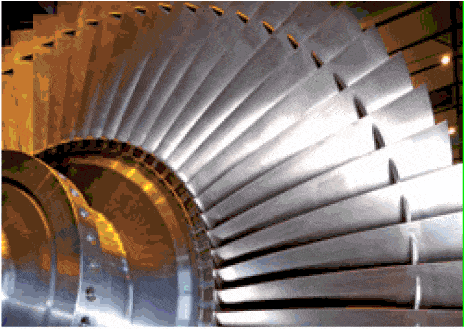
Figure 2 is an Alstom Nuclear LP Last Stage Blade Snubber Design intended to reduce fundamental blade vibration response.
Although such improvements provide benefits, there are inherent risks in their application.
New design last stage blades, for example, have a number of potential failure mechanisms that should be thoroughly analyzed and validated before being placed into service. Blade failure can result in unplanned blade replacement or worse, consequential damage requiring an extensive outage.
A new turbine or generator rotor, even if employing conventional technology, presents a different challenge. This is due to rotordynamic interactions introduced whenever a major train component is replaced. For example, a unit that was acceptable from a rotordynamic standpoint prior to retrofit may have torsional modes close to operating frequencies afterwards.
If this aspect is not thoroughly understood, evaluated and, if necessary, mitigated, the potential for major failures exist. This is a greater challenge when the retrofit supplier is not the original equipment manufacturer. Although this is an acceptable practice, it is important to verify the supplier has properly modeled the non-replaced train components when performing these analyses.
A structured technical review with an experienced and impartial third party is an excellent way to mitigate risks for any project. When conducted early in the planning process—such as during vendor selection or before the final award—this evaluation can help identify areas that need to be addressed through contractual requirements. Potential weak points where independent assessment is needed can be incorporated into the project schedule.
ENTRUST Solutions Group brings extensive industry experience and insights, drawing from challenges faced across all original equipment manufacturers and valuable lessons learned from troubleshooting efforts.
By applying this structured technical review approach on recent retrofit projects, ENTRUST identified key issues, including:
ENTRUST uncovered these issues through their systematic technical review process. This method was proven effective in 2011, during our retrofit design reviews for the Entergy Grand Gulf Nuclear Station, NextEra Point Beach Station and the GenOn Conemaugh Station.
Incorporating a structured technical review early in the retrofit planning process is key to minimizing risks and ensuring a successful outcome.
At ENTRUST, we leverage our expertise to help power plant owners navigate the complexities of turbine-generator retrofits, addressing potential issues before they become costly problems. By prioritizing thorough risk assessments, we help clients achieve improved reliability, efficiency, and extended operational life while safeguarding against unplanned downtime and failures.
Contact ENTRUST today to discuss how we can support your retrofit projects and ensure their success from start to finish.
***
Tom has spent the entirety of his 15-year career in the power generation industry.
In his current role as Vice President of Power Generation for ENTRUST, Tom oversees a team of approximately 100 engineers, whose expertise covers power plant equipment, modeling, and testing.
Prior to ENTRUST, Tom held turbine design and repair roles at General Electric. Tom is a graduate of GE’s Edison Engineering Development Program and holds 7 U.S. patents. He holds an BSME degree from Virginia Tech, an MSME degree from Georgia Tech, and is a registered professional engineer in the state of Delaware.

 (630) 353-4000
 info@entrustsol.com