By: Tom Reid, Vice President of Power Generation, ENTRUST Solutions Group
Turbines are the heart of power generation, and their performance relies on the precision and durability of every component. Among these, low-pressure turbine blades face some of the toughest challenges, operating in high-moisture environments that can lead to erosion and cracking over time.
Left unchecked, these issues can disrupt blade tuning, increase the risk of fatigue failure, and impact overall efficiency.
In this article, we’ll explore the causes of turbine blade damage, its impact on performance, and the steps utilities can take to inspect, repair, and restore blades to keep their turbines running smoothly.
The later stages of low pressure (LP) turbine blades operate in a low-quality steam environment. Design moisture levels can range from 1 or 2 percent all the way up to 15 percent. Units that suffer from reheat or main steam temperature drop at low loads can significantly increase moisture levels and subsequent erosion rates.
Trends among merchant plants have reduced the minimum load to the furthest degree possible to mitigate operating losses during low demand and energy pricing periods.
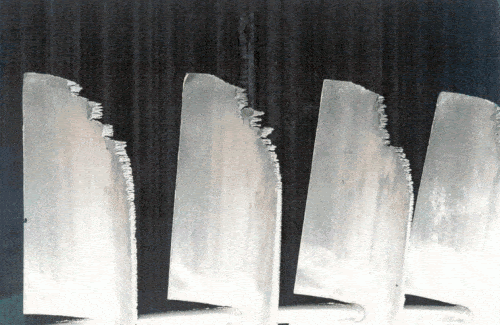
Figures 1a and 1b provide two examples of typical erosion damage in the last stages of a fossil LP design. As noted, there is a significant cutback and blade material loss from erosion. For these examples, the leading edge of the last stage included a soldered stellite shield to mitigate erosion. Other designs include induction-hardened leading edges to accomplish the same design task.
When making repair decisions, it is important to note later stage LP blades are tuned to avoid resonances at multiples of running speed. These blades experience vibratory steam excitation from:
LP blades see these upsets in steam flows as non-uniform steam pressures, velocities, and/or flow angles at multiples of running speed. If resonance exists between the natural frequency of a blade or blade group and fundamental multiples of running speed, high-cycle fatigue failures can occur.
The resulting vibratory response of the blade to this harmonic excitation will dictate whether one or more of the blade’s natural frequencies must be turned away from the harmonics of running speed.
For blade modes that cannot be tuned, keeping the resulting vibratory stresses below the endurance limit of the respective materials is necessary.
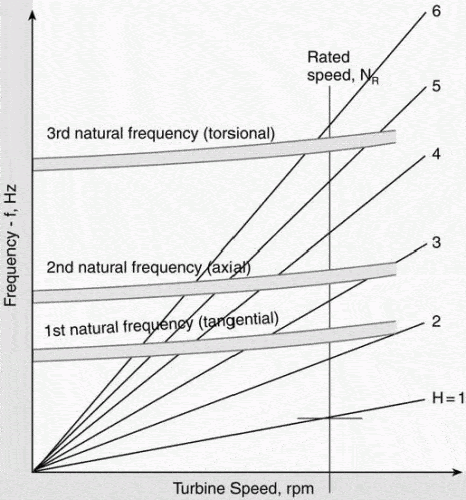
Figure 2 provides an example Campbell Diagram, which illustrates the number of modes that are typically tuned for a last-stage nuclear blade.
It is crucial to recognize the loss of blade material, from erosion to other causes, which can significantly alter a blade or group’s vibratory response away from design and, perhaps, reduce or eliminate margins from multiples of running speed. It is rarely a reasonable course of action to do nothing and leave severe erosion untouched.
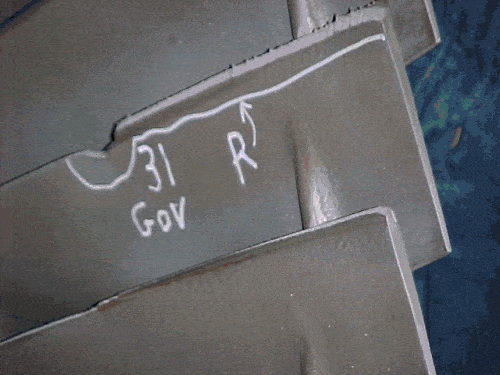
Figure 3 shows a silver solder and stellite repair in progress, which was completed by a major U.S. utility. The repair restored the original blade geometry.
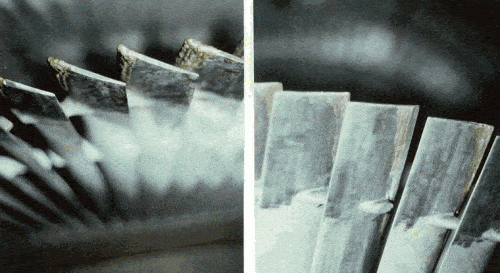
Low-pressure blade lacing wire (GE design) and lashing lug (Westinghouse/Siemens) cracking are common findings during major outage inspections of LP turbine blading (see Figure 4). The GE design lacing wire sometimes extends through multiple blades to form groups. The connection is typically brazed to the blade.
In other cases, the GE-type design is a loosely fitted wire that is intended to float in the blade hole and provide additional mechanical damping of the blade group. The Westinghouse/Siemens vintage blade design usually has a lashing lug that is Inconel welded to adjacent blades to form a pre-determined grouping of blade multiples.
Lashing wires and lugs are areas where it is common to find cracking. If not addressed, cracked lashing wires can produce unique and off-design blade frequencies that can lead to resonance failure. This should be an area where careful NDE is completed during an outage.
In some cases, removal of the brazed material is required to detect hidden blade cracking at this high-stressed location.
Fortunately, most cracking can be detected and repaired in place. Additional shot peening operations have been added to the lashing lug repairs to enhance high-cycle fatigue resistance.
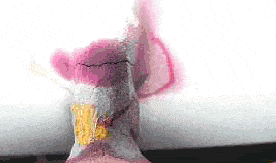
The later stages of low-pressure turbine blading are typically tuned to avoid resonance with fundamental steam excitation frequencies (typically up to the 8 harmonics of running speed). At these frequencies, LP blades see upsets in steam flows as non-uniform steam pressures, velocities, and/or flow angles.
Rapid high-cycle fatigue failure can occur if a blade’s natural frequency is resonant with one of these multiples of running speed.
Low-pressure blades with significant service time can suffer from water droplet erosion damage and cracked lashing lugs. This damage can significantly alter a blade or blade group’s natural frequency, which sometimes results in a resonance condition.
To avoid this condition, careful inspection and repair of lashing/lacing wire cracking must be completed. In addition, water droplet erosion damage will gradually remove blade material and cause blade natural frequencies to shift higher in their frequency band. If there is a sufficient margin, blade resonance can occur.
Options to restore/repair blade water droplet erosion damage that is described herein should be explored at each major outage if significant blade erosion is found.
Get in touch with our team of experts at ENTRUST today to discover how you can avoid turbine blade damage in your power generation operations, and keep your turbines running smoothly.
***
Tom has spent the entirety of his 15-year career in the power generation industry.
In his current role as Vice President of Power Generation for ENTRUST, Tom oversees a team of approximately 100 engineers, whose expertise covers power plant equipment, modeling, and testing.
Prior to ENTRUST, Tom held turbine design and repair roles at General Electric. Tom is a graduate of GE’s Edison Engineering Development Program and holds 7 U.S. patents. He holds an BSME degree from Virginia Tech, an MSME degree from Georgia Tech, and is a registered professional engineer in the state of Delaware.

 (630) 353-4000
 info@entrustsol.com