By Tom Reid, Vice President of Power Generation Services, ENTRUST Solutions Group
Reducing the minimum load of steam turbines and generators offers power plant operators the potential to increase revenue during periods of low energy demand. However, operating units at such low loads can push systems beyond their original design parameters, introducing a range of technical challenges.
This article explores key considerations for steam turbine and generator performance at super minimum loads, helping plant operators weigh the risks and rewards of such operations.
At super minimum loads, particles exfoliating from the boiler are throttled at much higher velocities through the inlet valves and, on units with partial arc admission, nozzle blocks. As a result, these components experience a greater erosion rate and may require more frequent maintenance.
One possible impact is nozzle vane erosion and chipping, as shown in Figure 1.
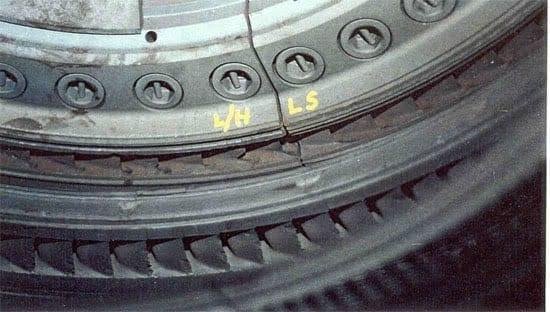
Treating the vanes with an erosion-resistant coating can mitigate nozzle block wear. A more permanent solution is to convert to sliding pressure operations. This approach also benefits heat rates by reducing thermodynamic losses due to throttling.
Units with partial arc admission where the lower arc valves open first are more susceptible to increased vibration at reduced minimum loads. This is due to unbalanced upward pressure forces that tend to lift the rotor and partially unload the HP-IP bearings.
Older units employing plain journal bearings may experience oil whip and related vibration at reduced bearing loads. A load test can determine if this is a concern, assuming proper supervisory instrumentation exists. Proper bearing clearances and preloads may be sufficient to overcome this concern. The operator can perform a load test and perform bearing adjustments at the next outage to determine if the minimum load can be reliably reduced.
If adjustments to the bearings alone do not address oil whip concerns, the operator has two options: change the admission sequence such that the cover valves open first or retrofit the unit with tilt-pad bearings. Changing the valve sequence can be problematic since bearing overload may result in reversed pressure loads. A tilt pad retrofit to maintain stability and acceptable bearing vibration level is often the best option.
Modern units already employ tilt pad bearings. However, even with tilt pads, maintaining correct clearances and preloads is important to ensure sufficient damping. Adding tilt pads to bear preloads normally addresses damping and sub-synchronous stability concerns.
Boiler temperature droop at lower loads typically occurs in both reheat and main steam conditions. Lower steam temperatures increase moisture levels and move the saturation line further upstream (near the Wilson Line) of the last stages of the Low-Pressure Turbine. At the Wilson line, chlorides become concentrated, and stress corrosion concerns are elevated.
Impingement of droplets on rotating blades accelerates damage to installed erosion shields and blade surfaces, as shown in the photo in Figure 2. If erosion damage is not eventually addressed, blade failure may result.
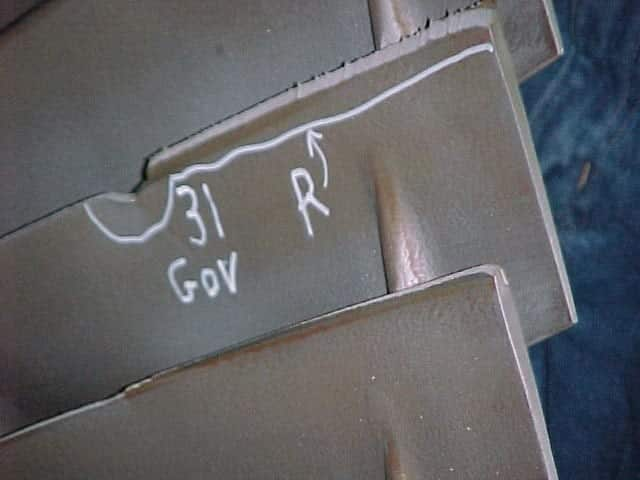
Running a test to optimize boiler operation and efficiency at minimum load is an important assessment part. Moving boilers tilts positive and frequent soot blowing can enhance temperature at these low loads. Sliding pressure may also support lower moisture levels if this capability exists.
During low load periods, boiler droop will cause temperatures to drop from nominal design conditions. This increases the fatigue effect of load swings from minimum to full load. Typically, the effect is minor, but depending on the amount of cycling, it can add up to impact casing and rotor cracking.
Typical locations for LCF cracking include diaphragm ledges, steam chest bridges, and ligaments between bolt holes. During a major outage, complete NDE should be done in these areas, and any detected cracks should be charted for length. The same should be repeated in subsequent outages to determine the propagation rate to support future repair decisions.
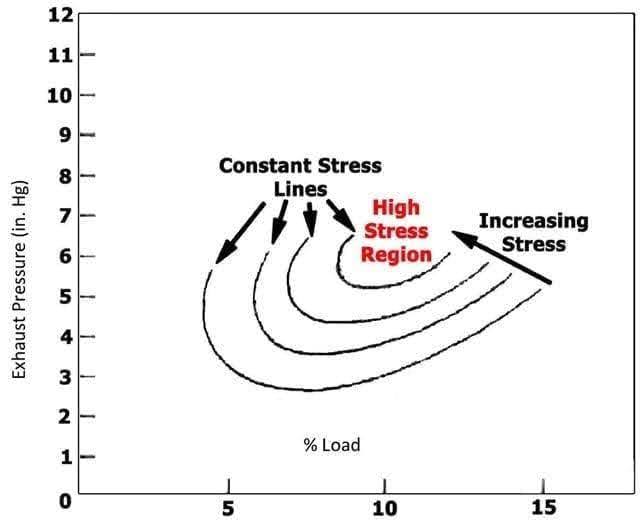
Stall flutter occurs when flow separation at the base of the blade forces steam to flow toward the tip. This can produce blade stall flutter vibrations and buffeting caused by flow instabilities. Longer blades with lower first-mode frequencies are more susceptible than shorter blades.
Figure 3 illustrates the high-stress conditions that can occur due to stall and blade buffeting vibration (note this figure is not intended for design; these curves vary by last stage blade design). Plots like these are derived from strain gauge data since traditional bearing vibration detection systems cannot detect blade vibrations.
In many regions of the country, some plants have load limitations during summer periods because of higher than acceptable back pressures due to inadequate condenser cooling. Unless this issue is addressed, low minimum load should be avoided during high back pressure conditions (typically over 4.5 inches hg).
Good operating practices such as frequent condenser tube and tube sheet cleaning can help provide additional margin at minimum loads.
Significant flow losses on the last stage blades at low loads result in higher heating (see stall flutter discussion). Hood temperatures are generally not problematic at super minimum loads, but they should be monitored and spray capabilities verified before testing.
It’s important to ensure the operation is still within the generator capability curve and to monitor stator slot RTDs, Hydrogen gas temperatures and generator rotor vibration.
Exhaust heating at reduced loads may result in additional differential expansion between stationary and rotating parts. These conditions should be carefully monitored during initial low load testing and trended as a function of load and time.
Although unlikely, thrust imbalances may develop. Temperature monitoring is a way to assess this risk.
Reach out to one of ENTRUST’s experts to find out more about how we can help you maximize your steam turbine and generator performance.
***
Tom has spent the entirety of his 15-year career in the power generation industry.
In his current role as Vice President of Power Generation for ENTRUST, Tom oversees a team of approximately 100 engineers, whose expertise covers power plant equipment, modeling, and testing.
Prior to ENTRUST, Tom held turbine design and repair roles at General Electric. Tom is a graduate of GE’s Edison Engineering Development Program and holds 7 U.S. patents. He holds an BSME degree from Virginia Tech, an MSME degree from Georgia Tech, and is a registered professional engineer in the state of Delaware.

 (630) 353-4000
 info@entrustsol.com